Monday, December 15, 2008

Ninja 250 Update

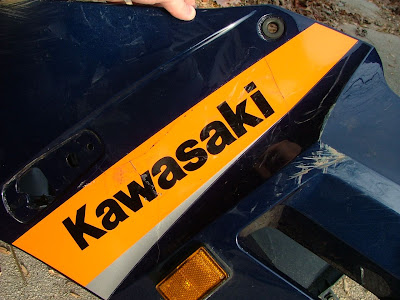
I finally got around to fixing up the damage I did to the 250 at the end of September. As you may recall, the left front turn signal punched through the fairing on its way to an untimely demise. I actually have some pictures to post of it and the restoration process.

Here it is after the fix. Hard to see the crack from the outside.

Next is the inside of the fairing where my friend Steve mended the plastic.

Here is what an OEM signal looks like.

This is what the turn signal looked like after the crash.

I put these flush-mount signals on as replacements. The pair of these (direct from Taiwan) cost less than one stock replacement would from Kawasaki.


Finally, I've gotten around to taking a picture of the bike with the repairs.

Thursday, December 11, 2008

The Gift Season

Around this time every year I start seeing Internet list of gifts to give for any and all demographics. A quick Google search shows that other people have compiled lists for motorcyclist gifts before me. I'm going to give it my best shot anyway. ;)

One idea would be the Crampbuster. It's kind of like a poor man's cruise control and a great way to relax your hand on the long haul. I haven't used one, but I have talked with riders who will swear by them for touring with and keeping your wrist from cramping up on high-mileage touring.

Another useful thing to have on your motorcycle is a bungee net, like Bikemaster's stretch net. It comes in colors to match your bike, too. I have used this to carry things like an extra helmet or a two-gallon fuel tank.

The next item I have for touring is another Bikemaster product, a mini-foot pump. It's compact and light so it packs well for touring. You never know when your tire might lose air and need to be re-filled. Normally this happens when you are in the middle of nowhere and can't get to a gas station to use their air-pump. Mini pump to the rescue!

In the same vein, a tire repair kit would make a great gift.

For the rider who is often found out in the rain, try finger squeegees. I don't want to think about the times last summer when I got caught by that little bit of rain or, worse yet, the wet roads and the mist that gets kicked up by the traffic around you. Every time that happened I told myself I would order these as soon as I got home. Still hasn't happened. If your biker is like me, these are for you.

The last useful item I will add to the list is a chin skirt for the helmet. Some manufacturers have things like this already built in, but more often you get to add your own. I found this little item to be one of the best ways to help keep my face warmer on the colder commutes. It really cuts down on wind and debris getting into your helmet.

Finally, if none of these sound right, find out what brand of gear they wear. Most makers have a line of non-motorcycling apparel as a way of showing your brand loyalty.

Note: I have no affiliation with any of the sites linked above. This post should not be construed as an endorsement of any specific retailer or manufacturer.

Monday, December 1, 2008

Ninja 250

As Matt said, we will both give a review of our respective sportbikes. Though we ride different machines, they are both good beginner rides. Mine is a 2005 Kawasaki Ninja 250, or EX250F19 (the EX designation for the non-race oriented sportbikes and the F19 for it being the 19th year of production.) The little Ninja is probably the most recommended beginner motorcycle in the sport classes. It gets these high praises by virtue of its low weight and low power. At around 350 pounds with roughly 25 horses it seems puny in comparison to its bigger brother the ZX-10, with four times the engine displacement, making 160 horses with a sub-400 pound weight.

The low power is part of the charm of the EX250 however. It has the power to comfortably cruise with highway traffic, and then some. At the same time, you have to learn proper shifting and transmission skill to keep it lively in traffic. It's not just a twist the wrist in any gear and go machine. The low weight is part of why it can get away with the small engine. The weight also is a plus when you accidentally horizontally park your bike.

Also, it has a less twitchy suspension than a full on race bike. While its handling is far more responsive than that of a cruiser like the Harley I had the opurtunity to ride a while back, it is not so responsive as to react to the minute inputs common to a rider still in the process of getting used to controlling a motorcycle. When a super-sport would swerve and turn, the little Ninja just gives a little lurch to remind you to keep your mind on the ride. This is not to say that it isn't a capable handler of the twists and turns or the times when a rider needs a quick response, but takes more awareness of what the rider is doing and, through that, is a wonderful way to learn how to ride and how to ride well.

Next up in the cross-hairs, the suspension and brakes. Both are less than stellar. The suspension is one of the things that long time owners often upgrade for heavier springs and more adjustability. The stock set-up has no adjustability and wonderfully soft front forks, lending the bike to extreme nose dives under heavy decelaration. This is not a totally bad thing though; it helps prevent the rear tire from coming up. However, the rear tire will still get light and lock up quickly without enough practice under extreme braking situations. (See my September 29th post.)

Last but not least, long term ownership: I know many people who consider the 250 to be a beginners bike that will go to the wayside as the rider's skill level progresses. I know more people who are highly experienced rider and looking for that used 250 to snap it up and use it as a commuter (65 miles to the gallon helps that midset) or to throw it around as a cheap track bike. I really enjoy being the owner of such a fine motorcycle and if I get told tomorrow that no one is allowed to buy or sell a motorcycle anymore than I will be pleased to be stuck with this one. In the picture below you can see that it even works well as a touring bike.

Tuesday, November 18, 2008

Motorcycle types: The Sportbike

In past posts, we've gone over standard motorcycles and cruisers. Now it's time to go over another common type, the sport bike. Sometimes you'll hear these called crotch rockets, but be careful what sort of riders you use that particular term around. Some sport bike riders will tell you that a crotch rocket is something you'd find at an adult bookstore instead of a Kawasaki dealership.

First, I'll need to define what separates a sport bike from a standard. The line isn't always obvious. Compare a Yamaha FZ6 to its close relative, the YZF-R6. The two look pretty similar, especially to a non-rider. So what's the difference?

The definition I'll use is that a sport bike is a performance oriented bike with a full fairing. That is, it has plastic or fiberglass bodywork to streamline it, and this bodywork extends from above the handlebars to below the engine. Standards like the FZ6 may have a bit of a fairing around the handlebars, but it doesn't cover the whole bike.

Now, you can divide sport bikes into two groups - race replica bikes and more street oriented ones that I'll call sport standards. A race replica bike is the roadgoing version of a bike built for track use, designed for setting the fastest lap times around a race track. The designer will sacrifice almost anything else - comfort, practicality, beginner friendliness - for a second off the lap times. Sport standards are more like a standard bike, just with extra streamlining.

Race replicas are not the easiest thing to learn on. They're usually the sort of bike that, to use a phrase I've heard often enough and long ago enough to forget who said it, will immediately do exactly what you accidentally tell it to. As a 600 cc race replica bike will often have more than 100 hp, you can accidentally tell it to do a lot. There are people who have learned to ride on these bikes, and there are also countless examples of race replica bikes sitting in used bike dealerships with less than 1,000 miles on the clock because the owner realized they had bought too much bike for them. These are the sort of bikes wise riders work their way up to by first learning on other bike.

Race replica bikes have a very leaned forward position. This makes it easy to tuck behind the windshield. Some riders put a bag on the tank and put something soft in it that they can lay flat on top of to make their race replica bikes more comfortabe. That would probably work well if you kept your rain gear in the tank bag. I would probably get in trouble if I tried that; I have a tank bag myself and find it just too handy a thing for hauling around a stash of banannas.

Sport standards are a good choice for that learning bike. They have their controls placed right where they'd naturally feel like they belong, they are meant to be ridden on the street, and the 500 cc and under class can make excellent first bikes. Like standards, a sport standard can do a surprising number of things well. They are at their best on twisty roads, but you can also take a sport standard on long trips, commute on one, or even ride one on gravel and graded dirt roads. The biggest disadvantage that a smaller sport bike will have over a similar standard or cruiser is that if you drop it, there's more bodywork to fix.

We've mentioned a couple of times that there are two typical red flags to warn a first time rider a bike is the wrong choice - a bike that is too powerful or too heavy. There's a couple different rules of thumb about too heavy for a first bike - some say 500 lbs, some say three times your body weight, or another rule of thumb is just don't pick one that will give you any trouble if it falls over. No matter which of these rules you pick, few sport bikes are too heavy. But they can easily be too powerful. Don't go over 50 hp if you're a beginning rider, at least not by more than a couple ponies. Learning to ride is a lot harder if you are also learning to control a machine that's twice as fast as anything you have ever driven.

Both Philip and I have sport bikes, so we will be posting reviews of them soon. And later, we're going to get into a couple other categories of bikes. Yes, there is more in the motorcycle world than cruisers and sport bikes.
Friday, October 31, 2008

The Harley 883

Since the last style of bike we talked about was the cruiser, I thought it appropriate to talk about riding one of the most well known names out there. I had the opportunity about a month ago to ride Harley-Davidson's Sportster 883 (actually, just hours before I crashed my Ninja.) For the 2009 production, Harley has two versions of the bike with their smallest engine. The 883 Low and the 883 Custom. The main differences are the seat height and foot control position, the Low has mid controls and a lower seat than the Custom with forward controls. I would have preferred the Low since I didn't like the idea of kicking my feet out in front of me, but it is pretty easy to get used to.


According to HD, the Sportster has a 28 inch seat height, 4.5 gallons in the tank, 55 ft lbs of torque, and weighs in at 590 lbs wet. It has a brutally simple instrument panel, speedometer and indicator lights only, and Harley's classic turn signal controls on both handlebars (rather than controlling them both with one thumb.) It also has the look that hasn't changed much in the fifty years that this model has been in production.

But, how does it ride, you eagerly ask. It's heavier than any production sportbike and it makes that fact known, but it also has a low center of gravity in comparison so it is still easy to stand up and hold. Twisting the throttle yields gobs of low end power, but even though it doesn't have the eyeball popping acceleration I found on Buell's 1125, it feels like you could use it to pull tree stumps out of the ground. The high handle bars and kicked out feet made for a very relaxed feeling on the straights but were less than confidence inspiring in turns. I suspect some one more used to the cruiser style would feel the same way if they got on a sportbike though.

Overall, the fit and finish of the motorcycle was impeccable and it was very comfortable, the throttle response was predictable and the clutch pull light and smooth. It would make a very nice second bike for someone interested in that style, but the weight and torque put it a little beyond what I would typically recommend that a new rider start on, even though I know several people who have gone this route.

Thursday, October 2, 2008

Motorcycle types: The Cruiser

Perhaps one of the most thought of styles of motorcycles is the cruiser. What makes it a "cruiser" is the frame geometry. They typically have lower seats, longer front forks, a more pronounced rake, and a longer trail (wikipedia has a decent article about frame geometry here.) All of that adds up to greater stability at high speed and a greater resistance to turning. Also, many cruisers have foot pegs farther forward than on a standard motorcycle, leaving your legs much straighter and in a more relaxed, reclining position. There are many cruisers to choose from, it is one of the most prolific classes of motorcycle, but few of them are suitable for riders new to the sport. Matt's rule of thumb about "under 50 hp" is easy to follow, but it is more difficult to find bikes under 3 times your body weight.


One such bike is the Honda Rebel.


The Rebel is a very common motorcycle and extremely inexpensive. If this is the style that appeals to you, start your search with looking at the Rebel or Suzuki's GZ250 or even the Kawasaki Eliminator 125 or Virago 250 (which has the more "traditional" V-twin look.)

Monday, September 29, 2008

Crashing

So, I get to type this post one-handed. Saturday afternoon was a lovely day for a ride, a little hot for the jacket I was wearing but not too bad. I decided to take a road I'd never been on, just to see if it went where I thought it did. Mistake number one. Almost immediately, the road started into what looked like a nice sweeping turn. Once I got about halfway through, I realized it was tightening down. Here is where I made the second mistake. Just days after I had been talking about discovering just how much looking all the way through the turn helps with stability and cornering, I look at the edge of the road in front of me. While I look in the wrong direction, I panicked about not being able to make the curve. Enter third mistake, I locked up my rear brake. The back tire started to slide out and I went straight off the road toward a slope down into a field. As soon as the tires hit the grass, they slide the other way, dumping me down into the ground elbow first.

I can't say enough about the kindness of strangers. By the time I stood up and gathered my wits, a bicyclist and the lady driving behind me had stopped and the biker was starting to pick up my motorcycle. Three motorcyclists also stopped when they saw me and called the EMTs for me, since I couldn't move my arm to get to my phone.

Basically, one broken front fairing, smashed turn signal, a few bruises, and one dislocated shoulder later, I learned a few things I would like to share and hopefully help some one else avoid my mistakes. First, sometimes riding the speed limit is too fast, especially when you're on unfamiliar ground. Second, look where you want to go. Had I looked through the turn, I would have reacted better to conditions. Third, and this goes with the second, lean more in the turn. I had plenty of lean angle left, I just didn't trust my tires and bike like I should have. Besides, if I had been further leaned over, I wouldn't have had as far to fall. ;)