Showing posts with label Machine. Show all posts

Saturday, August 11, 2012

Bike review: BMW F650GS

Alright, so I had the chance to ride a 2007 BMW F659GS today. A friend of mine left it in town to sell and told me to look after it. Then he said there is a nice loop near the storage unit.... Put two and two together...

Here it is:

Here are the basics: 652 cc single, 50 hp, chain drive, 5 speed, and all is 386 pounds.

This is a taller bike than I have ridden before, so a slight worry about getting my feet down. But, I could get my toes down once I put weight on the bike, so a little more comfortable. The seating position is pure standard. Feet almost half way between being under my knees and under my hips; arms slightly extended out to the wide bars. I know the mirrors look pretty small in the picture, but keep in mind that those hand guards are plenty over-sized and the mirrors are almost as large.

On to the ride: the power delivery is smooth and predictable, coming with a light clutch pull and wide friction zone. Goose the throttle and you get a strong pull from the big thumper, but not so much as to be intimidating.

The rake felt more relax than the bikes I'm used to, so less twitchy than a sportbike. Accordingly, the steering was heavier than I expected, but once it leaned over, it stayed planted.

Lastly, the brakes: I didn't try to do any full braking (borrowed bike, remember?) but they were also predictable and gave pretty good feedback. I don't know if the bike had ABS, but I wasn't about to find out.

Overall, it is a fantastic ride, and a relatively new rider should be able to handle it pretty well. Assuming they are tall enough to feel comfortable with the height. Also, it reminded me I need a bike of my own.

Friday, April 29, 2011

After-market Modification

I looked at the Blast earlier this week and noticed something; the exhaust is starting to rust. The all steel construction of the system and the lack of a garage to protect it from the elements will do that. Seems like I now have a savings goal: a new after-market can for the bike. Too bad the two brands I would like to see put on it also add 5-10 HP. Oops.

Whenever it gets done (in the next 5 years, or so) I'll post up more about it.

Thursday, September 3, 2009

Quick tips

Just a couple of quick tips to tide people over as I work on a full post (next topic: helmets)

First, when you get new tires put on the bike, the handling changes. I put some Pirelli MT75s on the Ninja yesterday to replace the stock Dunlop K630s, which you may recall were getting pretty worn. Not only are the new tires rounded, the new rear tire is slightly smaller than the original. The combination of these factors lead to a faster turn-in than I was used. Add to that the fact that the Pirellis have better grip than the Dunlops and you get me grinning in my helmet all the way home from the shop.

Second, a little something I discovered on my way to get the tires replaced. I had not warmed up my engine enough to turn off the choke, but I did it anyway. Meaning that I stalled coasting to a red light. No problem, I thought, I'll just put the bike in first and pop the clutch to pop-start it. Bad idea. I should have remembered to put the bike in second gear to pop-start. Instead I locked the rear wheel and slid the back end out momentarily before I engaged the clutch and allowed it to turn freely again. Slightly embarrassed, I just turned the choke back on and hit the starter button.

Thursday, April 16, 2009

SHAD luggage - first impression

The SHAD luggage arrived yesterday. I'm pretty busy with a book deadline and the MegaMeet coming up, so I can't install it right away. But I couldn't resist pulling it out of the box and having a look. Here are my first impressions.

The very first thing I noticed is that it's big. Each side case is 42 liters. You could fit a helmet into one of these. A single side case looks like it's about the same volume as both my current saddlebags and my tank bag put together. They'll definitely make my bike more useful for running errands, or if I want to go on a road trip a couple days long.

The quality looks pretty good too. There was a scratch in the powder coating on the mounts in one place, looks like it may have happened in transit. The cases themselves are a fairly nice looking matte finished plastic. The frames look like they've been welded together with a MIG by someone who knew what he was doing. It's not the most immaculate welding I've ever seen, but it looks like it'll hold up and there isn't too much spatter. By the way, the bar for "the most immaculate welding I've ever seen" is a pretty high one, as my former employer had a YAG laser welder that seemed able to defy the laws of thermodynamics.

I'll put it to one of the real tests of quality soon enough - seeing how well it fits the bike. But it looks like a pretty comprehensive kit.

Saturday, April 4, 2009

Hard luggage for a GS500F

I've had a set of Cortech saddlebags on my GS500F for a little more than a year. They are quite handy for carrying rain gear, stashing warm clothes when the weather heats up, or putting a to-go box in when I've got leftovers from the Mellow Mushroom. But they don't stand up all that well to the elements. They are not fully waterproof, and the top of them has faded from red to a washed out pink. The sides still look OK, and I suspect the black saddlebags may hold up a bit better, but still, I've been thinking I should upgrade to hard luggage.

Finding a bolt on kit for hard luggage for a GS500F isn't easy. Sure, I could fabricate something, but I don't mind spending a bit extra if it saves me a lot of time. Givi and many of the other major manufacturers don't have kits to put hard saddlebags on this particular bike. They do have bolt on top case kits, but for some reason, I'd rather have a set of saddlebags. Five Star sells a bolt on mounting kit, but it's very expensive (around $500 without the bags) and their dealers list it as special order.

Finally, I managed to find an eBay auction for a set of Shad luggage that included a bolt on mounting kit. I know, there's an obvious joke that this sounds fishy. But I did a bit of looking around, and I've turned up that Shad luggage is made in Spain and there are quite a few positive reviews of their luggage kit for another Suzuki, the DL650 V-Strom. So today I ordered a luggage kit for the bike off eBay. I'll let you know how it turns out.

Saturday, March 21, 2009

Non-Routine Maintenance

For some time now the Ninja has been having what I thought to be problems with the carburetor being dirty. What I mean is that when the throttle got opened wide, the engine would bog down and sometimes stall. Pretty clearly some sort of fueling issue.

Here is where it comes in handy to either be a good mechanic or know one. A friend of ours (the same one who fixed my fairing) came over this morning to help me take the carb off and give it a thorough cleaning. When he got the carb off of the engine (in about the same amount of time as it takes me to get the fairing off) we discovered that the vent hose that helps regulate the air flow had a kink in it.
Like so:


We cut this section off the hose and re-installed everything. Took it out for a test ride and everything was back to the way it should be. The bike should now be reliable enough for me to get back to commuting regularly on it next week.

Saturday, March 7, 2009

Suzuki GS500F

I've been meaning to post a review of my own bike for a while. I ride a 2005 Suzuki GS500F. It's one of the more commonly recommended beginner sport bikes. This doesn't mean it is slow by car standards; I used to have a C4 Corvette, and the GS500F was a bit faster up to any legal speeds. I'd say that it is still suitable for most people as a first time bike, if you've scored well on the exams at the MSF class. If you're feeling uncertain after the class, though, something like a Ninja 250 or Buell Blast might be a better choice as they are a bit easier to ride.

The GS500 has been around since the late '80s, but Suzuki gave it a major styling update in 2004 to make the GS500F. Without the decals, you'd have a difficult time telling a GS500F from a GSX-R600 unless you look at it closely enough to spot the difference in handlebars or manage to catch a glimpse of the cooling fins under the bodywork. It seems that F may stand for "fairing," but the naked (that is, no plastic bodywork) version was called the GS500E, and I'm not entirely sure what, if anything, the E stood for.

Power comes from an air cooled parallel twin, with two valves per cylinder. It slots in between the Ninja 250 and Ninja 500 for overall power, making somewhere in the vicinity of 50 hp. It redlines at 11,000 RPM and is quite happy cruising at around 5,000. Like I said earlier, the power to weight ratio is a little bit higher than an '80s era Corvette. It is enough power to get you in trouble if you don't respect it... but unlike a 600 cc supersport, you need to show it some pretty blatant disrespect. It typically gets around 50 to 60 miles to the gallon.

The one point where it can be a bit unforgiving is the rear brake. It has a single hydraulic disc at each end, and if you panic and stomp on the brake pedal, it can lock the rear wheel. You'll want to make a point of using the front brake a lot more heavily than the rear.

Handling is pretty agile without being twitchy. It's certainly a fun bike to attack twisty roads with. If pushed to the limit, it's not as sophisticated as a supersport or a more expensive sport-standard like a Buell Lightining, but it's still a lot of fun. It's also quite stable in crosswinds, even though it's not a particularly heavy bike. Heavy is relative here, though - it feels a bit heavier than a Ninja 250, Buell Blast, or most of your common MSF range bikes. It's lighter than the CX500 I used to ride, and about the same weight as a 600 cc supersport.

The one area I'd want to improve on is comfort. It's not too bad to ride about town, but ride it for an hour or more and you'll start wanting a better seat. Kawasaki arguably does a better job with their factory seats on the Ninja, and unlike Ninjas, there are few aftermarket seats available for a GS500F. I'm also 6'2" tall and my legs start feeling a little bit cramped on a very long ride, though I could probably ignore that if it wasn't for the seat. I've got to wonder why the aftermarket hasn't stepped up, as there's quite a few of these bikes out there and it's definitely an item that owners could use. The riding position itself is quite comfortable; it's fairly upright with a little bit of forward lean. I modified the handlebar mounts on mine to make it friendlier for a tall rider.

There is one weird "gotcha" about owning a GS500F. For some reason, many of the parts books list the wrong oil filter. Don't let them sell you a spin on filter like the one you'd put on a car; the correct filter is a cartridge that sits inside the engine and looks more like a miniature automotive air filter.

Here's how I would sum this bike up.

Good points:
  • Enough power to be fun without getting out of hand for the beginning rider
  • Contemporary sportbike styling
  • Sporty handling
Bad points:
  • Really needs a better seat

Thursday, January 1, 2009

The New Year's Offerings

With the advent of 2009, I think we should look at this year's offerings from the major manufacturers in motorcycles that I would recommend to someone who made a resolution to learn to ride this year. Well, actually I would tell them to look for something used, but if they insist on a new bike, these are what I would want them to take a look at.

From Yamaha:
If you're looking into the cruiser segment, Yamaha's V Star line has several from which the beginner may choose.

First off is the V Star 250, formerly named the Virago 250, this has been one of the recommended bikes for years running. With a low weight of 324 pounds and only 250cc in the engine it fits the bill quite nicely. It even looks good.

If you don't feel that it fits you, check into the slightly larger V Star 650. It comes in three styles; the Silverado, a fully loaded touring machine, the Classic, a flowing cruiser, or the Custom, a factory bobber.

Unfortunately, if you're looking for a sport bike, I can't tell you to look at the Yamaha line. But any of the dual-sports offered would work well. Especially the distinctive TW200.

Next manufacturer up is Honda:
Big Red has one bike for the beginner's cruiser. The Rebel. As mentioned in an earlier post, the Rebel is one of the most recommended bikes for several reasons, not the least of which are the 234cc engine or the wet weight of 331 pounds.

Disappointingly, Honda has discontinued the next motorcycle I would have recommended, the Nighthawk. However, they have added a few that I would jump at the chance to try out, the CRF230M and the CRF230L. With both of them having sub-300 pound curb weights and massive give in the suspensions, they would be great fun to throw around in city traffic.

With a few more styles comes Suzuki:
The first of the manufacturers to have a sport bike that I would recommend, the GS500F. The heaviest of the bikes I've mentioned so far, it tips the scales a little north of 400 pounds. It also is the bike the Matt has been using for the duration of this blog, so any review of it will be his.

Suzuki also has the requisite dual-sports in the DR-Z400S and SM version. However, I would only recommend these to those very long of leg and able to get their feet down from these towering seats. Or those with more normal sized legs, the DR200SE has a seat four inches lower.

Finally, Suzuki offers several in the standard/cruiser segment. From the GZ250 (a prime competitor to the Rebel) to the Boulevard S40 (single cylinder) or the S50 (for those more into the v-twin market.)

Last of the Big 4, Kawasaki:
Kawasaki is the only one to have two bikes in the sportbike category suitable for the first time rider. The smallest two editions of the Ninja line come in both a 250cc and a 500cc engine. For those of you who have followed our blog have seen my older 250 and know how much I love it need to hear no more about it, for those who haven't heard yet... Well, I like it a lot and you'll just have to read more of our posts to find out why. The Ninja 500 hasn't had the luxury of the update that it's smaller sibling received, but it's still a bullet-proof choice.

From the cruiser side of the street, Kawasaki offers both the Eliminator 125 (another favorite of the MSF classes and great for tooling around town) and the Vulcan 500 (sharing the same engine as the Ninja mentioned above.)

As far as dual-sports go, any one of the Kawasakis in this category are great to start on, even the KLR 650 if you can sit it.

The last of the major manufacturers who have a bike I would recommend for someone to start on has just one; Buell's big single, the 500cc Blast. If you missed my reaction to this wonderful addition to the playing field, go back and read it, Buell has decided not to mess with success on this one.

Monday, December 15, 2008

Ninja 250 Update

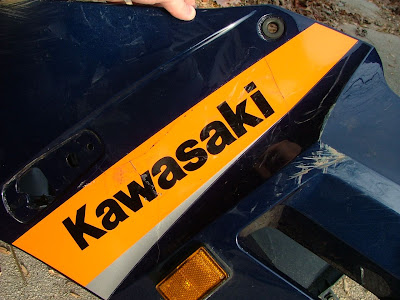
I finally got around to fixing up the damage I did to the 250 at the end of September. As you may recall, the left front turn signal punched through the fairing on its way to an untimely demise. I actually have some pictures to post of it and the restoration process.

Here it is after the fix. Hard to see the crack from the outside.

Next is the inside of the fairing where my friend Steve mended the plastic.

Here is what an OEM signal looks like.

This is what the turn signal looked like after the crash.

I put these flush-mount signals on as replacements. The pair of these (direct from Taiwan) cost less than one stock replacement would from Kawasaki.


Finally, I've gotten around to taking a picture of the bike with the repairs.

Monday, December 1, 2008

Ninja 250

As Matt said, we will both give a review of our respective sportbikes. Though we ride different machines, they are both good beginner rides. Mine is a 2005 Kawasaki Ninja 250, or EX250F19 (the EX designation for the non-race oriented sportbikes and the F19 for it being the 19th year of production.) The little Ninja is probably the most recommended beginner motorcycle in the sport classes. It gets these high praises by virtue of its low weight and low power. At around 350 pounds with roughly 25 horses it seems puny in comparison to its bigger brother the ZX-10, with four times the engine displacement, making 160 horses with a sub-400 pound weight.

The low power is part of the charm of the EX250 however. It has the power to comfortably cruise with highway traffic, and then some. At the same time, you have to learn proper shifting and transmission skill to keep it lively in traffic. It's not just a twist the wrist in any gear and go machine. The low weight is part of why it can get away with the small engine. The weight also is a plus when you accidentally horizontally park your bike.

Also, it has a less twitchy suspension than a full on race bike. While its handling is far more responsive than that of a cruiser like the Harley I had the opurtunity to ride a while back, it is not so responsive as to react to the minute inputs common to a rider still in the process of getting used to controlling a motorcycle. When a super-sport would swerve and turn, the little Ninja just gives a little lurch to remind you to keep your mind on the ride. This is not to say that it isn't a capable handler of the twists and turns or the times when a rider needs a quick response, but takes more awareness of what the rider is doing and, through that, is a wonderful way to learn how to ride and how to ride well.

Next up in the cross-hairs, the suspension and brakes. Both are less than stellar. The suspension is one of the things that long time owners often upgrade for heavier springs and more adjustability. The stock set-up has no adjustability and wonderfully soft front forks, lending the bike to extreme nose dives under heavy decelaration. This is not a totally bad thing though; it helps prevent the rear tire from coming up. However, the rear tire will still get light and lock up quickly without enough practice under extreme braking situations. (See my September 29th post.)

Last but not least, long term ownership: I know many people who consider the 250 to be a beginners bike that will go to the wayside as the rider's skill level progresses. I know more people who are highly experienced rider and looking for that used 250 to snap it up and use it as a commuter (65 miles to the gallon helps that midset) or to throw it around as a cheap track bike. I really enjoy being the owner of such a fine motorcycle and if I get told tomorrow that no one is allowed to buy or sell a motorcycle anymore than I will be pleased to be stuck with this one. In the picture below you can see that it even works well as a touring bike.

Tuesday, November 18, 2008

Motorcycle types: The Sportbike

In past posts, we've gone over standard motorcycles and cruisers. Now it's time to go over another common type, the sport bike. Sometimes you'll hear these called crotch rockets, but be careful what sort of riders you use that particular term around. Some sport bike riders will tell you that a crotch rocket is something you'd find at an adult bookstore instead of a Kawasaki dealership.

First, I'll need to define what separates a sport bike from a standard. The line isn't always obvious. Compare a Yamaha FZ6 to its close relative, the YZF-R6. The two look pretty similar, especially to a non-rider. So what's the difference?

The definition I'll use is that a sport bike is a performance oriented bike with a full fairing. That is, it has plastic or fiberglass bodywork to streamline it, and this bodywork extends from above the handlebars to below the engine. Standards like the FZ6 may have a bit of a fairing around the handlebars, but it doesn't cover the whole bike.

Now, you can divide sport bikes into two groups - race replica bikes and more street oriented ones that I'll call sport standards. A race replica bike is the roadgoing version of a bike built for track use, designed for setting the fastest lap times around a race track. The designer will sacrifice almost anything else - comfort, practicality, beginner friendliness - for a second off the lap times. Sport standards are more like a standard bike, just with extra streamlining.

Race replicas are not the easiest thing to learn on. They're usually the sort of bike that, to use a phrase I've heard often enough and long ago enough to forget who said it, will immediately do exactly what you accidentally tell it to. As a 600 cc race replica bike will often have more than 100 hp, you can accidentally tell it to do a lot. There are people who have learned to ride on these bikes, and there are also countless examples of race replica bikes sitting in used bike dealerships with less than 1,000 miles on the clock because the owner realized they had bought too much bike for them. These are the sort of bikes wise riders work their way up to by first learning on other bike.

Race replica bikes have a very leaned forward position. This makes it easy to tuck behind the windshield. Some riders put a bag on the tank and put something soft in it that they can lay flat on top of to make their race replica bikes more comfortabe. That would probably work well if you kept your rain gear in the tank bag. I would probably get in trouble if I tried that; I have a tank bag myself and find it just too handy a thing for hauling around a stash of banannas.

Sport standards are a good choice for that learning bike. They have their controls placed right where they'd naturally feel like they belong, they are meant to be ridden on the street, and the 500 cc and under class can make excellent first bikes. Like standards, a sport standard can do a surprising number of things well. They are at their best on twisty roads, but you can also take a sport standard on long trips, commute on one, or even ride one on gravel and graded dirt roads. The biggest disadvantage that a smaller sport bike will have over a similar standard or cruiser is that if you drop it, there's more bodywork to fix.

We've mentioned a couple of times that there are two typical red flags to warn a first time rider a bike is the wrong choice - a bike that is too powerful or too heavy. There's a couple different rules of thumb about too heavy for a first bike - some say 500 lbs, some say three times your body weight, or another rule of thumb is just don't pick one that will give you any trouble if it falls over. No matter which of these rules you pick, few sport bikes are too heavy. But they can easily be too powerful. Don't go over 50 hp if you're a beginning rider, at least not by more than a couple ponies. Learning to ride is a lot harder if you are also learning to control a machine that's twice as fast as anything you have ever driven.

Both Philip and I have sport bikes, so we will be posting reviews of them soon. And later, we're going to get into a couple other categories of bikes. Yes, there is more in the motorcycle world than cruisers and sport bikes.

Friday, October 31, 2008

The Harley 883

Since the last style of bike we talked about was the cruiser, I thought it appropriate to talk about riding one of the most well known names out there. I had the opportunity about a month ago to ride Harley-Davidson's Sportster 883 (actually, just hours before I crashed my Ninja.) For the 2009 production, Harley has two versions of the bike with their smallest engine. The 883 Low and the 883 Custom. The main differences are the seat height and foot control position, the Low has mid controls and a lower seat than the Custom with forward controls. I would have preferred the Low since I didn't like the idea of kicking my feet out in front of me, but it is pretty easy to get used to.


According to HD, the Sportster has a 28 inch seat height, 4.5 gallons in the tank, 55 ft lbs of torque, and weighs in at 590 lbs wet. It has a brutally simple instrument panel, speedometer and indicator lights only, and Harley's classic turn signal controls on both handlebars (rather than controlling them both with one thumb.) It also has the look that hasn't changed much in the fifty years that this model has been in production.

But, how does it ride, you eagerly ask. It's heavier than any production sportbike and it makes that fact known, but it also has a low center of gravity in comparison so it is still easy to stand up and hold. Twisting the throttle yields gobs of low end power, but even though it doesn't have the eyeball popping acceleration I found on Buell's 1125, it feels like you could use it to pull tree stumps out of the ground. The high handle bars and kicked out feet made for a very relaxed feeling on the straights but were less than confidence inspiring in turns. I suspect some one more used to the cruiser style would feel the same way if they got on a sportbike though.

Overall, the fit and finish of the motorcycle was impeccable and it was very comfortable, the throttle response was predictable and the clutch pull light and smooth. It would make a very nice second bike for someone interested in that style, but the weight and torque put it a little beyond what I would typically recommend that a new rider start on, even though I know several people who have gone this route.

Thursday, October 2, 2008

Motorcycle types: The Cruiser

Perhaps one of the most thought of styles of motorcycles is the cruiser. What makes it a "cruiser" is the frame geometry. They typically have lower seats, longer front forks, a more pronounced rake, and a longer trail (wikipedia has a decent article about frame geometry here.) All of that adds up to greater stability at high speed and a greater resistance to turning. Also, many cruisers have foot pegs farther forward than on a standard motorcycle, leaving your legs much straighter and in a more relaxed, reclining position. There are many cruisers to choose from, it is one of the most prolific classes of motorcycle, but few of them are suitable for riders new to the sport. Matt's rule of thumb about "under 50 hp" is easy to follow, but it is more difficult to find bikes under 3 times your body weight.


One such bike is the Honda Rebel.


The Rebel is a very common motorcycle and extremely inexpensive. If this is the style that appeals to you, start your search with looking at the Rebel or Suzuki's GZ250 or even the Kawasaki Eliminator 125 or Virago 250 (which has the more "traditional" V-twin look.)

Saturday, August 30, 2008

Motorcycle types: The Standard

If you're looking to get into motorcycling, the first thing I'd recommend doing is taking a riding class. Once that's done and you have your license (or in some states, before you have your license), you'll need to pick out your gear and your bike. Many newcomers think of bikes in two kinds, cruisers and sport bikes. However, there's a lot of other styles to pick from, even if some of them are much less common.


I'm going to start this series on bike types with one of the less frequently seen types today, the standard motorcycle. The reason is that once you've got a good idea of what a standard is, it's easier to understand the differences between most of the other styles. Another reason I'm starting out with this type is that standard bikes are a pretty good choice for your first bike. As you might expect, they're called standards because for a long time this was what you got if you wanted a motorcycle. In the 1980s, bikes became a bit more specialized and the standard became something of a niche product by the mid '90s.


Here's a good example of a beginner friendly standard, the Buell Blast. The Honda Nighthawk 250 is another example of a good standard for a first time rider - in fact, both of these bikes put in a lot of workhorse duty in riding classes. Standard bikes can range in style from traditional to modern, but there's a few things they all have in common.

The biggest one is their riding position. On a standard bike, you sit upright on the seat and your feet are either beneath your hips or slightly in front of them. There's usually not much bodywork, although some of them have a small windshield or a bit of a fairing. A good standard can do a bit of everything - they're a bit sporty, reasonably comfortable, and can even do all right on a gravel road. This makes them a great choice if you're not sure exactly what sort of riding you'll be doing when you get started out.

If you're looking for a standard, it's hard to pin down an exact engine size for a beginner to avoid as manufacturers have put all sorts of different engine types in here from detuned racing engines to motors intended strictly for low maintenance street riding. A good rule of thumb is no more than 50 hp and no more than three times your body weight.

Wednesday, July 16, 2008

Smooth looking bike.


Saw a Honda Pacific Coast while riding home yesterday. I've heard it described as ahead of it's time in design. After actually seeing one on the road, I have to agree and add that if you like spaceships this is the bike for you. (Picture from Wikipedia: http://en.wikipedia.org/wiki/Honda_Pacific_Coast)
Now I want to test ride one...

Tuesday, July 1, 2008

Dubious Legality

So as I was driving home from grabbing a sandwich from the Publix deli this evening, I was admiring the two Gixxers in the lane next to me. They had followed me out of the parking lot and looked to be pretty competent at low speeds and hadn't been doing anything stupid as they cruised to the light with me.

As I admired, one of the riders explained to the other that he needed to practice holding his license plate so that traffic cameras couldn't get a picture of it. Then they learned back a bit and flipped the plates down onto the wheel guard. Yes, the plates were on hinges.

Now, I'm no expert, but I'm pretty sure there can be no good or legal reason for that particular mod.

Saturday, May 10, 2008

I Test Rode a Buell Today

I went in to ask if I could test ride the XB12Ss Lightning, but they didn't roll that out. I got a brand spanking new 1125R. I secretly wanted to test that one, but was afraid to ask for it. I mean really, go from a 30 hp Ninja 250 onto a 146 hp BEAST....

So, after I got over my shock, I swung a leg over and discovered that I can tip toe it, but not flat foot. Ok, a little worried about that but when I pulled it upright I found out another fun little fact: this bike weighs in under 400 pounds and is incredibly well balanced. Once we got out onto the road I found the throttle to be very predictable and the clutch pull smooth and not terribly grabby, good for someone who's a bit worried about keeping the front wheel down. I didn't get a lot of practice on the transmission, since I only once got up the third but it had some of the expected Buell/HD "clunk" when it shifted.

On the open straightaways I took the chance to open the throttle a bit and was rewarded with gut-wrenching, socket-pulling acceleration and the brakes were more than equal to the task of pulling the speed back down. The bike just begs you to tuck in and when you give in it's almost relaxing. On a hot day I wouldn't be able to do it since I was completely protected from any wind. Even when I sat upright, I had a great wind pocket.

The controls were all a little stiff, but I think that may be due to it being new and unfamiliar. The rear brake lever felt small and tucked away, but once I figured out where it was I managed it.

Oh, and the handling, oh my, the handling. The best way to describe it is: think where you want to go and it happens. I never took it on any good turns, but even low speed parking lot maneuvering was easy. At stops I almost never had to put my feet down to keep it balanced, either.

All in all, my complaints are as follows. It was almost impossible to find the kickstand at the end of the ride and I don't have the money or skill it requires.

Here is my disclaimer. The 1125R is an amazing machine. It is also too much machine for me right now. I have not developed the skills required by a bike built to race. The Buell is built to be as user friendly as possible, but it is not beginner friendly.

Sunday, March 23, 2008

Good motorcycles for first time riders

It's a question that I see all over the Internet, and probably would see more often in person if I knew more people who were looking to become motorcyclists: "What's the best bike for a first time rider?" Nearly half the time, somebody replies, "A Kawasaki Ninja 250." It's easy to understand why, as that's one of the best bikes out there for first time riders. But there are plenty of other good choices. Some of these recommendations would be similar for everyone, while others I'd say depend on the rider. The reason the Ninja 250 gets recommended so often is that it fits a lot of riders, not to mention a lot of budgets. There's even quite a few experienced riders who keep a Ninja 250 around.

Unfortunately most dealerships won't let you test ride bikes. In some cases, I suspect the salesman who says "Sure, this bike would be perfect for you!" secretly fears you have little chance of bringing it back in one piece if you test rode it. Other bike dealers will hire a sales staff that doesn't even have motorcycle licenses. There's some good salesmen out there who will point you towards a bike that matches your abilities, but too many who are thinking of their own commission.

In some countries, the choice is made for you - they have a set of rules about what bike you can get after you first get your license, and you have to stick with them. I'll assume you live in the United States or another country that lets you buy anything when you have a license.

I've often heard people recommend waiting until after you take riding lessons to pick out your first bike. I didn't and Philip did. But I think it's a good idea. It's possible you may find that a particular type of motorcycle you wanted, or even motorcycling itself, doesn't really fit you. And it's also possible that you may find you like the bike they assigned you in the class enough that you'd want one just like it. Some classes even have several different bikes and let you ride different ones. This does seem to be the exception rather than the rule, as it appears to be more common that you'll be assigned one bike and stay with it throughout the class.

If you leave the class thinking that the bike you rode there is all you are ready to handle at the moment, I'd recommend getting a 250 cc bike as your first bike, or maybe a Buell Blast (which is what they use in Harley classes). These are light, controllable, and predictable. You may leave the class feeling you're ready for a bit more. Here are some rules of thumb about how to avoid getting too much more. These are what I'd recommend for a first bike.

1. It needs to have forgiving and predictable handling. Although horsepower doesn't say much about the chassis or braking, it's a good predictor on modern bikes of how the rest of the bike will behave. I definitely wouldn't recommend more than 60 hp for your first bike. You may think that's a bit small, but a sport bike with rider will typically weigh somehwere around 600 lbs. 60 hp in a sport bike is like having a Mustang with 350 hp, only a Mustang isn't quite as much at risk of falling over if you break the rear wheels loose in a corner. On sportbikes (or bikes with sportbike-based engines, like a Yamaha FZ6), that means no more than 500 ccs. A 600 may not seem like much of a jump, but the 600 cc sportbikes are built for all out power. A Yamaha YZF-R6, for example, can put over 110 hp to the rear wheels. That's over twice what Motorcycle.com measured from a Ninja 500. With cruisers or dirt-oriented machines, you can get a bit larger than 500 cc.

2. A bike that's too heavy can be a handful for a beginning rider to control, too. A good rule of thumb is to keep it under 500 lbs and get a bike that's light enough you can pick it up if it falls over, without any help. If you can pick it up, there's less of a chance you will actually have to.

3. Being able to keep your feet flat on the ground when you're at a stop is also very helpful to the beginning rider. Most riders should be able to find a good bike they can "flat-foot" - that is, get both feet flat on the ground when sitting in the saddle. If you're under 5'2" you may have to settle for getting the balls of your toes on the ground instead. But an average sized rider shouldn't make that compromise.

4. You ought to pick a bike that'll fit you. You should be able to find one that meets these guidelines that you feel comfortable sitting on, that fits your budget, and that looks like your idea of what a motorcycle should look like. There are quite a few bikes out there that are appropriate for first-timers, so you don't have to settle for a cruiser if you really wanted a sport bike, or vice versa.

Thursday, March 13, 2008

Introducing my bike

It's not a Gixxer, but it plays one on TV.

One thing that I really ought to do is explain what sort of bike I'm riding. It's a 2005 model Suzuki GS500F. While even people who don't ride motorcycles have often heard of the Katana and GSX-R lines, the GS500F is a bit more obscure. It's the last member of Suzuki's GS line, a series of air cooled bikes that competed with the Honda CB and Kawasaki KZ lineup. The GS series were practical all-around bikes. All three of these lineups have faded from popularity as motorcycles have become more specialized. The GS500 survived by disguising itself as a GSX-R with some plastic body panels. Except for the decals, you have to look at it pretty closely to tell it's not a Gixxer.

A GS500F doesn't act like a GSX-R when you're in the saddle, however. While the GSX-R line was designed for winning races, the GS line was designed to be comfortable, practical street riding bikes. So while a GS500F is pretty quick by car standards, it is still the sort of bike that's forgiving and predictable enough to be a first bike. While fast enough to keep up with my 1986 Corvette off the line, it isn't the sort of thing that will lock the brakes with the slightest touch or give you an unprovoked wheelie. It's the sort of bike that a beginning rider will still need to treat with respect, but not fear.

Another way in which it differes from the GSX-R is the riding position. You're not leaned forward like on a race replica bike. The riding position keeps your body upright like a cruiser unless you make an effort to lean forward. Unlike a cruiser, though, your feet are more or less under you. It's fairly comfortable to ride for about an hour or so, but the seat starts to feel like a 2 x 4 after that. You'll see me trying ways to improve that soon enough.

Since the picture was taken, I've made a few minor changes to improve it for commuting. One, I've put some homemade bar risers on it. Two, I've equipped it with a set of Cortech saddle bags. These let me carry around a rain suit and various other things that I might need for comfort on the ride or for work. I also use a magnetic tank bag, which is just the right size to pack a lunchbox into. You can fit a surprising amount of luggage on a sport bike. I've thought about getting a matching top bag that snaps onto the saddlebags, and I can also wear a backpack if I need to carry even more stuff.